


New NPMA Form 33 Does Not Say You MUST Treat for Termites
TERMITE TREATMENT RULES AND NPMA FORM 33
Does your pest control company understand its own regulations when it comes to termites?
I do not hold a Pest Control Operator (PCO) license in Kentucky. I am not giving you advice on when or where to treat for subterranean termites. I am solely focused on making sure that my clients have the clearest and up-to-date information on all matters related to their homes.
In this post, I want to clarify the consumer information that is shared by the National Pest Management Association regarding subterranean termites and when treatment should be recommended. Everything we do as inspectors should be in the best interest of our clients, and it appears that in regards to some pest “professionals,” that does not seem to be the case.
Recently, it has been brought to my attention that several pest control companies in my area of Louisville, KY are instructing home buyers, home sellers, and real estate agents that they are required to treat for termites (at a cost sometimes reaching several thousand dollars) when in reality, they don’t. Shady business practice? Honest mistake? I don’t know. But here are the facts:

EVERY Pest Control Operator (PCO) in Kentucky MUST USE a form produced by the National Pest Management Association when performing a Wood Destroying Insect (WDI) inspection in Kentucky. A new version of this form came out at the beginning of 2020 (click here to see the changes), and that revision is what has sparked all the controversy. The guidelines that a PCO follows for this report are on the back of each one. If you’d like to see those consumer guidelines in their entirety, click here.
What we need to break down is paragraph #2 on the back page. Below is the excerpt which seems to be creating the confusion. I say confusion because I don’t want to believe that these companies are lying to people just to get more termite treatment jobs…but there is a heck of a lot of revenue being generated from treatments if companies are ‘forced’ to treat every home that isn’t under “warranty coverage” or that “hasn’t been treated in 5 years.” I have been told that both of these reasons have been used recently…and it’s just not true.
NPMA FORM 33 – WHAT IT SAYS AND WHAT IT DOESN’T SAY
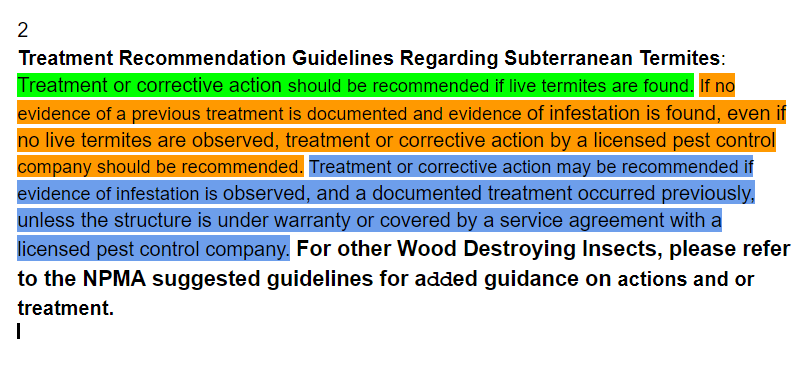
Below is the actual text from the back page of the NPMA Form 33. Since this text is dense and can be confusing to read, I’ve broken it down into 3 sections, indicated by color. Let’s discuss what each section means in real-world language we can understand. A few things to keep in mind here:
- The term ‘treatment’ or ‘treat’- This means to kill the termites. It is usually done with a chemical flood treatment of the soil around the house, but some companies choose a bait station for treatments instead.
- Evidence of infestation- This means that the inspector sees damage to wood, or more commonly, sees the mud tubes that termites construct to protect themselves (also known as shelter tubes).
- Warranty Coverage– Like everything else in life, your pest company is going to try and sell you an extended warranty after they treat your house. Most companies give you a 12-month guarantee on the initial treatment that termites will not return. After that first 12 months is up, they will offer to put your home under ‘warranty coverage’ where they will come back every year and inspect for a recurrence of the termites. If by some chance they are found, the company will treat that spot. The fee for this service is a yearly expense.
SECTION 1 GREEN:
Treatment or corrective action should be recommended if live termites are found.
This section is easy and straightforward. If you have a termite inspection performed on a house and live termites are found, you should have the home treated (kill the termites).
SECTION 2 ORANGE:
If no evidence of a previous treatment is documented and evidence of infestation is found, even if no live termites are observed, treatment or corrective action by a licensed pest control company should be recommended.
This section is a little wordy, but basically it is saying that if evidence of a past infestation is found (like old shelter tubes), the inspector should recommend treatment if he/she cannot find evidence or written proof of a past treatment…regardless of whether or not live termites are seen.
SECTION 3 BLUE:
Treatment or corrective action may [emphasis added] be recommended if evidence of infestation is observed, and a documented treatment occurred previously, unless the structure is under warranty or covered by a service agreement with a licensed pest control company.
This last part is what has caused all the fuss. It states that an inspector MAY recommend treatment if evidence of past termites is found, even if they find signs of past treatment, unless the treatment is under some type of warranty coverage by another pest control company (see above bullet point about warranty coverage).
Using the word ‘may’ implies that something is an option, but is not required. If the text said ‘shall’ or ‘must’ in lieu of ‘may,’ we would be having a much different conversation. But it doesn’t. And telling people that the new regulations “require” you to re-treat the house is underhanded lying and stealing…and any company participating in such activities should be ashamed of itself.
If a pest control company wants to set a company policy that they recommend treatment if the home is “5 years post-treatment and not under warranty,” Fine. But that information should be disclosed to the customer as their policy, and not a law or requirement. It is my understanding that there are several pest control companies telling folks that treatment in this case is part of the new rules, and that is simply not true.
Do your homework. Be informed. Advocate for yourself…and don’t let the “professionals” deceive you.
Note: I’ve requested a clarification from the Kentucky Department of Agriculture on this topic, but haven’t heard back as of this publishing. I’ll update this post as soon as I do.





I am a lpco, and as an operator who believes in being ethical we are running into these same problems plus some from local and National companies in our area of bowling green. You are spot on. This new form wording I truly believe was done with the best of intentions, however they’re are companies out there using it to make a quick buck. Unfortunately the home seller is at a great disadvantage they can refuse to treat but most likely will miss out on the sale of there home. I hate that people in our industry has stooped to this level it gives us all a bad name.
Hi Justin – Thanks for chiming in. I’m with you 100%. One bad apple spoils the bunch.
I am a lpco, and as an operator who believes in being ethical we are running into these same problems plus some from local and National companies in our area of bowling green. You are spot on. This new form wording I truly believe was done with the best of intentions, however they’re are companies out there using it to make a quick buck. Unfortunately the home seller is at a great disadvantage they can refuse to treat but most likely will miss out on the sale of there home. I hate that people in our industry has stooped to this level it gives us all a bad name.
Hi Justin – Thanks for chiming in. I’m with you 100%. One bad apple spoils the bunch.